
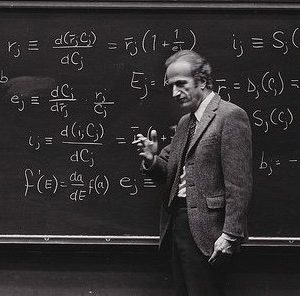
The Becker Friedman Institute for Economics (BFI) serves as a hub for cutting-edge analysis and research across the entire University of Chicago economics community, uniting researchers from the Booth School of Business, the Kenneth C. Griffin Department of Economics, the...
Inspired by our namesakes, Nobel Laureates Gary Becker and Milton Friedman, who believed that economics research could help improve the world, BFI works with the Chicago Economics community to turn its evidence-based research into real-world impact.
The Predoctoral Research in Economics Program (PREP) is intended to serve as a bridge between college and graduate school for students interested in empirical economics. The program offers unique research and professional training opportunities at the University of Chicago.
Expanding Discovery in Economics+ (EDE+) brings together a diverse group of early undergraduate students to hone their research abilities and technical skills.
As Large Language Models (LLMs) are increasingly tasked with autonomous decision-making, understanding their behavior in strategic settings is crucial. We investigate the choices of various LLMs in the Ultimatum Game, a setting where human behavior notably deviates from theoretical rationality....
Sam Asher, Kritarth Jha, Paul Novosad, Anjali Adukia, and Brandon Tan
We study residential segregation and access to public services across 1.5 million urban and rural neighborhoods in India. Muslim and Scheduled Caste segregation in India is high by global standards, and only slightly lower than Black-White segregation in the U.S....
In this chapter, we develop a framework for analyzing the determinants of economic development and their implications for policy. We distinguish between classical determinants—such as inputs into education and health, access to credit, and geography—and non-classical determinants—including cultural values, social...
Captivating and informative videos on the latest insights and trends as well as the tested stock of knowledge in economics from leaders in academia, policy, business, and the media.
The Predoctoral Research in Economics Program (PREP) is intended to serve as a bridge between college and graduate school for students interested in empirical economics. The program offers unique research and professional training opportunities at the University of Chicago.
Life at BFI / UCHICAGO
In addition to working closely with faculty as research assistants, predoctoral research professionals typically attend classes and seminars at BFI and affiliate institutions. Additional opportunities include a rigorous customized orientation workshop, annual career development retreat, and individual mentorship.
PREDOCTORAL RESEARCH PROFESSIONALS
Program participants in this or similar positions have gone on to Economics Ph.D. programs at Harvard, MIT, University of Chicago, Stanford, University of California, Berkeley, Princeton, LSE, and similar schools upon program completion.
Related News
Stay up to date on Predoctoral Research in Economics program (PREP) news and announcements.
The Becker Friedman Institute for Economics (BFI) serves as a hub for cutting-edge analysis and research across the entire University of Chicago economics community, uniting researchers from the Booth School of Business, the Kenneth C. Griffin Department of Economics, the...
Inspired by our namesakes, Nobel Laureates Gary Becker and Milton Friedman, who believed that economics research could help improve the world, BFI works with the Chicago Economics community to turn its evidence-based research into real-world impact.
The Predoctoral Research in Economics Program (PREP) is intended to serve as a bridge between college and graduate school for students interested in empirical economics. The program offers unique research and professional training opportunities at the University of Chicago.
Expanding Discovery in Economics+ (EDE+) brings together a diverse group of early undergraduate students to hone their research abilities and technical skills.
As Large Language Models (LLMs) are increasingly tasked with autonomous decision-making, understanding their behavior in strategic settings is crucial. We investigate the choices of various LLMs in the Ultimatum Game, a setting where human behavior notably deviates from theoretical rationality....
Sam Asher, Kritarth Jha, Paul Novosad, Anjali Adukia, and Brandon Tan
We study residential segregation and access to public services across 1.5 million urban and rural neighborhoods in India. Muslim and Scheduled Caste segregation in India is high by global standards, and only slightly lower than Black-White segregation in the U.S....
In this chapter, we develop a framework for analyzing the determinants of economic development and their implications for policy. We distinguish between classical determinants—such as inputs into education and health, access to credit, and geography—and non-classical determinants—including cultural values, social...
Captivating and informative videos on the latest insights and trends as well as the tested stock of knowledge in economics from leaders in academia, policy, business, and the media.