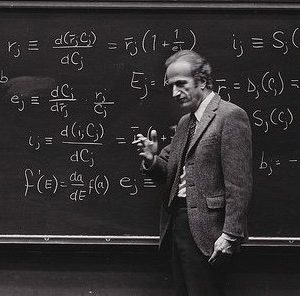
The Becker Friedman Institute for Economics (BFI) serves as a hub for cutting-edge analysis and research across the entire University of Chicago economics community, uniting researchers from the Booth School of Business, the Kenneth C. Griffin Department of Economics, the...
Inspired by our namesakes, Nobel Laureates Gary Becker and Milton Friedman, who believed that economics research could help improve the world, BFI works with the Chicago Economics community to turn its evidence-based research into real-world impact.
The Predoctoral Research in Economics Program (PREP) is intended to serve as a bridge between college and graduate school for students interested in empirical economics. The program offers unique research and professional training opportunities at the University of Chicago.
Expanding Discovery in Economics+ (EDE+) brings together a diverse group of early undergraduate students to hone their research abilities and technical skills.
In plausibly calibrated heterogeneous-agent models, marginal propensities to consume (MPCs) are highly non-linear in wealth, falling sharply away from borrowing constraints. As a result, the aggregate consumption response to a fiscal transfer is strongly concave in its size: larger transfers...
Julie Pernaudet, John List, Arnoldo Müller-Molina, Majid Ahmadi, Imrul Huda, Ajay Sailopal, and Dana Suskind
Parents play a critical role in shaping children’s skills during the first years of life. Yet, identifying the contributors to richer learning environments remains difficult due to various unobservable factors. In this paper, we combine field experiments with AI to...
Kristina Butaeva, Steven Durlauf, and Alexander Shapoval
This paper examines intergenerational mobility across social classes during the late Qing dynasty employing a remarkable data set from Liaoning province in Northeast China. We identify two distinct epochs with markedly different mobility dynamics. Before 1850, mobility patterns exhibited stability...
Captivating and informative videos on the latest insights and trends as well as the tested stock of knowledge in economics from leaders in academia, policy, business, and the media.
This paper considers the problem of testing whether there exists a non-negative solution to a possibly under-determined system of linear equations with known coefficients. This hypothesis testing problem arises naturally in a number of settings, including random coefficient, treatment effect, and discrete choice models, as well as a class of linear programming problems. As a first contribution, we obtain a novel geometric characterization of the null hypothesis in terms of identified parameters satisfying an infinite set of inequality restrictions. Using this characterization, we devise a test that requires solving only linear programs for its implementation, and thus remains computationally feasible in the high-dimensional applications that motivate our analysis. The asymptotic size of the proposed test is shown to equal at most the nominal level uniformly over a large class of distributions that permits the number of linear equations to grow with the sample size.
The Becker Friedman Institute for Economics (BFI) serves as a hub for cutting-edge analysis and research across the entire University of Chicago economics community, uniting researchers from the Booth School of Business, the Kenneth C. Griffin Department of Economics, the...
Inspired by our namesakes, Nobel Laureates Gary Becker and Milton Friedman, who believed that economics research could help improve the world, BFI works with the Chicago Economics community to turn its evidence-based research into real-world impact.
The Predoctoral Research in Economics Program (PREP) is intended to serve as a bridge between college and graduate school for students interested in empirical economics. The program offers unique research and professional training opportunities at the University of Chicago.
Expanding Discovery in Economics+ (EDE+) brings together a diverse group of early undergraduate students to hone their research abilities and technical skills.
In plausibly calibrated heterogeneous-agent models, marginal propensities to consume (MPCs) are highly non-linear in wealth, falling sharply away from borrowing constraints. As a result, the aggregate consumption response to a fiscal transfer is strongly concave in its size: larger transfers...
Julie Pernaudet, John List, Arnoldo Müller-Molina, Majid Ahmadi, Imrul Huda, Ajay Sailopal, and Dana Suskind
Parents play a critical role in shaping children’s skills during the first years of life. Yet, identifying the contributors to richer learning environments remains difficult due to various unobservable factors. In this paper, we combine field experiments with AI to...
Kristina Butaeva, Steven Durlauf, and Alexander Shapoval
This paper examines intergenerational mobility across social classes during the late Qing dynasty employing a remarkable data set from Liaoning province in Northeast China. We identify two distinct epochs with markedly different mobility dynamics. Before 1850, mobility patterns exhibited stability...
Captivating and informative videos on the latest insights and trends as well as the tested stock of knowledge in economics from leaders in academia, policy, business, and the media.