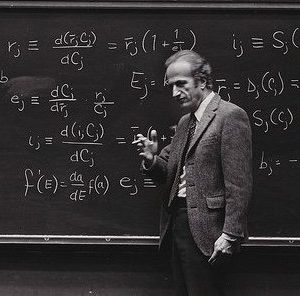
The Becker Friedman Institute for Economics (BFI) serves as a hub for cutting-edge analysis and research across the entire University of Chicago economics community, uniting researchers from the Booth School of Business, the Kenneth C. Griffin Department of Economics, the...
Inspired by our namesakes, Nobel Laureates Gary Becker and Milton Friedman, who believed that economics research could help improve the world, BFI works with the Chicago Economics community to turn its evidence-based research into real-world impact.
The Predoctoral Research in Economics Program (PREP) is intended to serve as a bridge between college and graduate school for students interested in empirical economics. The program offers unique research and professional training opportunities at the University of Chicago.
Expanding Discovery in Economics+ (EDE+) brings together a diverse group of early undergraduate students to hone their research abilities and technical skills.
Amy Finkelstein, Matthew Notowidigdo, and Charlie Rafkin
We analyze the food stamp program both as a potential investment in children’s health capital and as a redistributive tool by studying the 1979 reform that made food stamps free. We leverage geographic variation in exposure to the reform, which...
Terence Chau, Philip J. Cook, Javier Lopez, Jens Ludwig, Alejandro Roemer, and Adam K. Soliman
Program impact estimates that are not statistically significant are often treated as providing little guidance for policy choice, even when economically important effects remain plausible. In such cases, the decision-relevant task is not simply to test whether the effect differs...
At COP28 in Dubai, 198 countries agreed to transition away from fossil fuels (TAFF) in energy systems “in a just, orderly and equitable manner” (UNFCCC 2024). The COP30 Presidency has developed a roadmap of concrete actions towards this goal, with...
Captivating and informative videos on the latest insights and trends as well as the tested stock of knowledge in economics from leaders in academia, policy, business, and the media.
In plausibly calibrated heterogeneous-agent models, marginal propensities to consume (MPCs) are highly non-linear in wealth, falling sharply away from borrowing constraints. As a result, the aggregate consumption response to a fiscal transfer is strongly concave in its size: larger transfers shift households out of high-MPC regions and thereby dampen the consumption response. Across partial- and general-equilibrium settings, linear methods substantially overstate the effects of fiscal stimulus at empirically relevant sizes. Local methods are not reliable for studying shocks and policies where a failure of Ricardian equivalence is important.
The Becker Friedman Institute for Economics (BFI) serves as a hub for cutting-edge analysis and research across the entire University of Chicago economics community, uniting researchers from the Booth School of Business, the Kenneth C. Griffin Department of Economics, the...
Inspired by our namesakes, Nobel Laureates Gary Becker and Milton Friedman, who believed that economics research could help improve the world, BFI works with the Chicago Economics community to turn its evidence-based research into real-world impact.
The Predoctoral Research in Economics Program (PREP) is intended to serve as a bridge between college and graduate school for students interested in empirical economics. The program offers unique research and professional training opportunities at the University of Chicago.
Expanding Discovery in Economics+ (EDE+) brings together a diverse group of early undergraduate students to hone their research abilities and technical skills.
Amy Finkelstein, Matthew Notowidigdo, and Charlie Rafkin
We analyze the food stamp program both as a potential investment in children’s health capital and as a redistributive tool by studying the 1979 reform that made food stamps free. We leverage geographic variation in exposure to the reform, which...
Terence Chau, Philip J. Cook, Javier Lopez, Jens Ludwig, Alejandro Roemer, and Adam K. Soliman
Program impact estimates that are not statistically significant are often treated as providing little guidance for policy choice, even when economically important effects remain plausible. In such cases, the decision-relevant task is not simply to test whether the effect differs...
At COP28 in Dubai, 198 countries agreed to transition away from fossil fuels (TAFF) in energy systems “in a just, orderly and equitable manner” (UNFCCC 2024). The COP30 Presidency has developed a roadmap of concrete actions towards this goal, with...
Captivating and informative videos on the latest insights and trends as well as the tested stock of knowledge in economics from leaders in academia, policy, business, and the media.