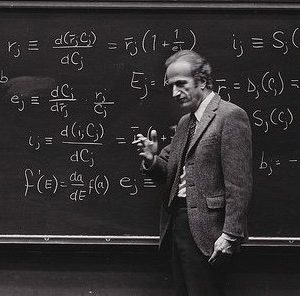
The Becker Friedman Institute for Economics (BFI) serves as a hub for cutting-edge analysis and research across the entire University of Chicago economics community, uniting researchers from the Booth School of Business, the Kenneth C. Griffin Department of Economics, the...
Inspired by our namesakes, Nobel Laureates Gary Becker and Milton Friedman, who believed that economics research could help improve the world, BFI works with the Chicago Economics community to turn its evidence-based research into real-world impact.
The Predoctoral Research in Economics Program (PREP) is intended to serve as a bridge between college and graduate school for students interested in empirical economics. The program offers unique research and professional training opportunities at the University of Chicago.
Expanding Discovery in Economics+ (EDE+) brings together a diverse group of early undergraduate students to hone their research abilities and technical skills.
Christopher Campos, Pablo Muñoz, Alonso Bucarey, and Dante Contreras
This paper studies how college major choices shape earnings and fertility outcomes. Using administrative data that link students’ preferences, random assignment to majors, and post-college outcomes, we estimate the causal pecuniary and non-pecuniary returns to different fields of study. We...
Leonardo Bursztyn, Ewan Rawcliffe, and Hans-Joachim Voth
We study the ability of a firm to elicit repeated effort from workers by creating a “rat race” of hierarchical status-based incentives. We examine performance using data on over 5,000 German air force pilots during World War II. Pilots’ effort...
Honesty is perceived as fundamental to societal functioning, motivating education systems worldwide to enforce strict oversight and heavy penalties for dishonest behavior. Yet much academic misconduct remains unexposed, and its broader consequences are further obscured by the sorting of individuals...
Captivating and informative videos on the latest insights and trends as well as the tested stock of knowledge in economics from leaders in academia, policy, business, and the media.
The Becker Friedman Institute for Economics (BFI) serves as a hub for cutting-edge analysis and research across the entire University of Chicago economics community, uniting researchers from the Booth School of Business, the Kenneth C. Griffin Department of Economics, the...
Inspired by our namesakes, Nobel Laureates Gary Becker and Milton Friedman, who believed that economics research could help improve the world, BFI works with the Chicago Economics community to turn its evidence-based research into real-world impact.
The Predoctoral Research in Economics Program (PREP) is intended to serve as a bridge between college and graduate school for students interested in empirical economics. The program offers unique research and professional training opportunities at the University of Chicago.
Expanding Discovery in Economics+ (EDE+) brings together a diverse group of early undergraduate students to hone their research abilities and technical skills.
Christopher Campos, Pablo Muñoz, Alonso Bucarey, and Dante Contreras
This paper studies how college major choices shape earnings and fertility outcomes. Using administrative data that link students’ preferences, random assignment to majors, and post-college outcomes, we estimate the causal pecuniary and non-pecuniary returns to different fields of study. We...
Leonardo Bursztyn, Ewan Rawcliffe, and Hans-Joachim Voth
We study the ability of a firm to elicit repeated effort from workers by creating a “rat race” of hierarchical status-based incentives. We examine performance using data on over 5,000 German air force pilots during World War II. Pilots’ effort...
Honesty is perceived as fundamental to societal functioning, motivating education systems worldwide to enforce strict oversight and heavy penalties for dishonest behavior. Yet much academic misconduct remains unexposed, and its broader consequences are further obscured by the sorting of individuals...
Captivating and informative videos on the latest insights and trends as well as the tested stock of knowledge in economics from leaders in academia, policy, business, and the media.