




Generative AI arrived in classrooms with unusual speed and little precedent for how schools should manage it. Emerging evidence suggests AI can support learning when paired with structured guidance but can undermine it without guardrails. In this way, whether AI narrows or widens educational disparities may depend less on who has access to it than on which schools have built the capacity to guide its use.
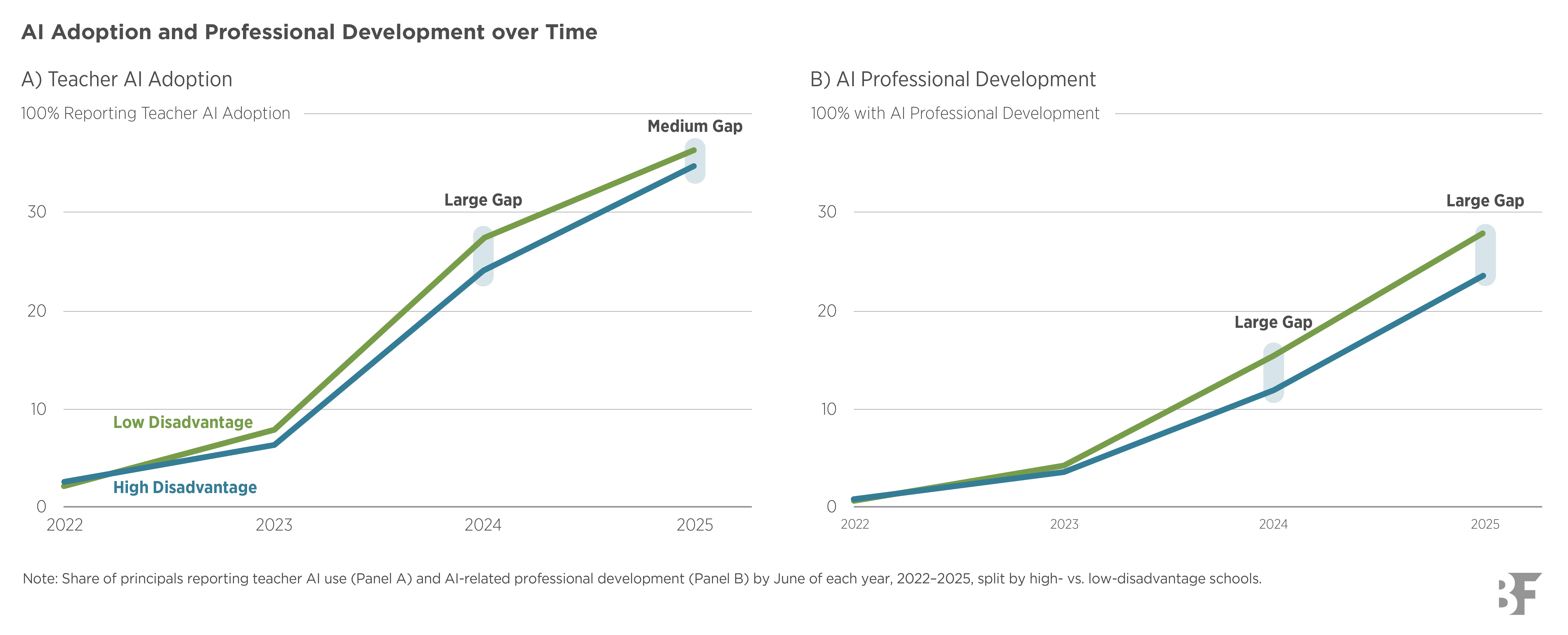
In this paper, the authors study not just whether schools use AI, but how. They draw on an original national survey of more than 1,200 K-12 principals designed to measure institutional integration of AI in schools through policies, teacher training, guidance for student use, leadership engagement, and the availability of AI-enabled tools. The survey reveals the following:
- Teacher use of generative AI rose from just 6% of schools in 2022 to 90% by 2025.
- The institutional scaffolding around that use has not kept pace with this fast adoption, however.
- Diffusion has occurred in a decentralized, bottom-up manner, rather than as the result of coordinated policy initiatives.
- Schools have largely set their own approaches, overwhelmingly allowing AI use with guidelines rather than banning it. Most principals report no written AI policy.
- Use by teachers has outpaced professional development and training on AI tools, with only 64% of schools offered any AI-related professional development as of 2025.
The authors next turn to understanding how AI is used by students and educators.
- Use remains largely supplemental, with students mainly turning to AI for homework help and essay drafting.
- Eighty-eight percent of principals report that AI rarely or never replaces classroom instruction.
- Views on effectiveness are mixed: 30% of principals report that AI has not improved student learning, while 25% believe it has.
- Educators use it mainly as a productivity tool for lesson planning and administrative work, not as a driver of instructional change.
The authors then compare AI integration across schools. Using a composite index: a single summary score built by combining several related measures into one, so that overall patterns can be compared across cases even when no single measure fully captures the concept of policy, training, guidance, and tools, the authors find integration is systematically lower in two kinds of schools:
- Schools serving more economically disadvantaged students score lower per standard deviation of disadvantage, a pattern that holds across multiple measures of disadvantage.
- Charter and private schools score lower than traditional public schools despite having more autonomy to adopt new practices.
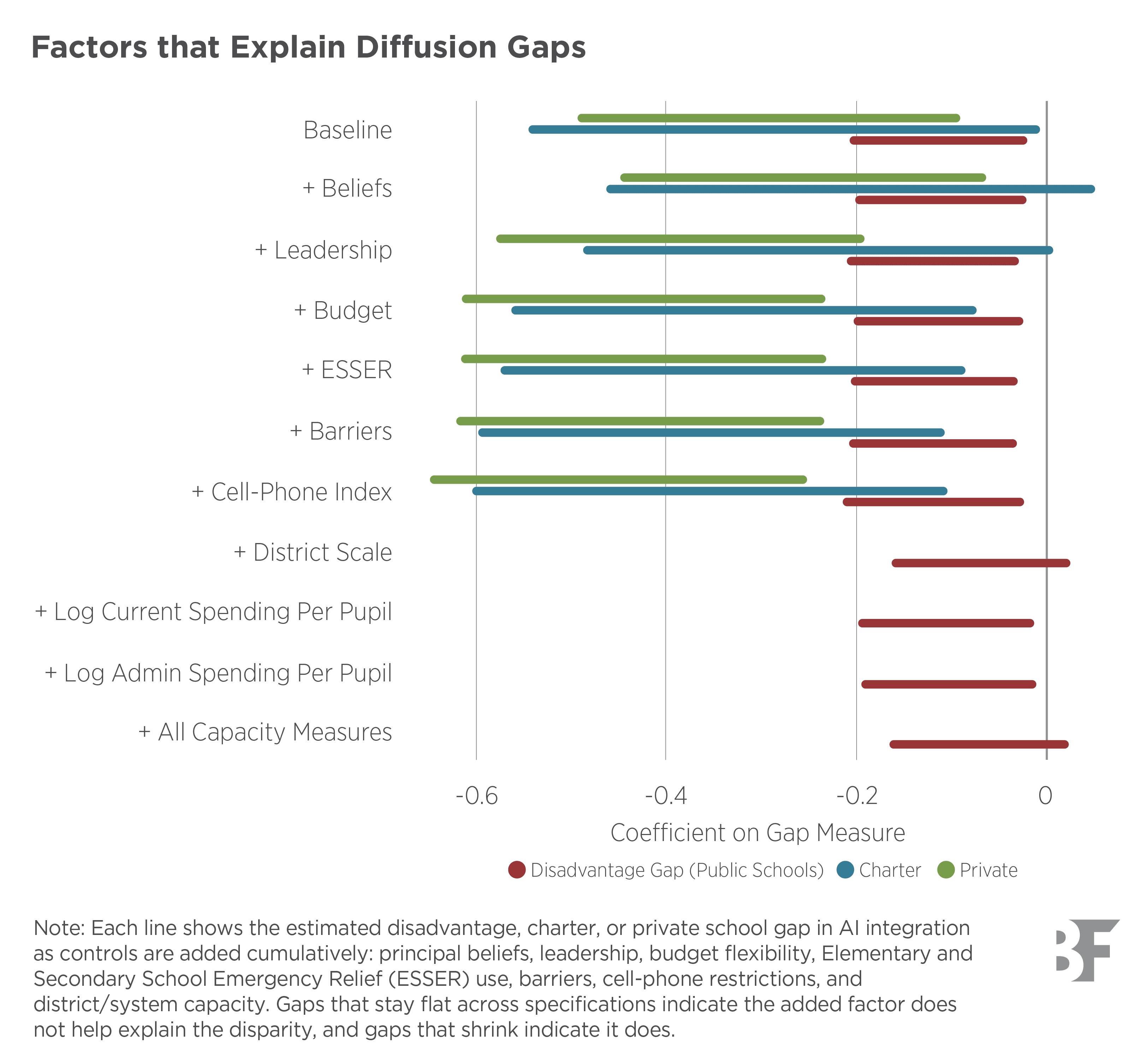
Finally, the authors distinguish predictors of integration levels from mediators of integration gaps.
- Schools where principals believe that AI improves learning tend to have the highest levels of AI integration, followed by those where teachers champion the tool and those with more flexible budgets.
- None of these factors, however, meaningfully narrows the take-up gaps across different kinds of schools because the factors aren’t distributed schools in a way that explains the disparities.
- The one factor that does appear to explain integration gaps across schools is district scale. Larger districts show meaningfully higher integration, and accounting for scale closes over a third of the disadvantage gap, more than per-student spending does.
This research has direct implications for policies aimed at driving effectiveness. Because the conditions that raise integration levels differ from those that would close integration gaps, policies aimed at boosting principal enthusiasm or discretionary spending are unlikely to reduce disparities by themselves. System-level capacity factors such as district scale, vendor reach, and implementation infrastructure seem to be more promising levers, and a more important axis of inequality than access to AI tools themselves.