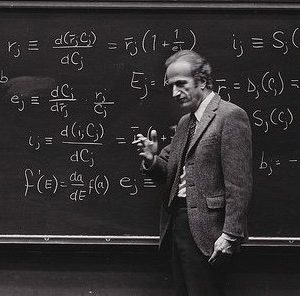
The Becker Friedman Institute for Economics (BFI) serves as a hub for cutting-edge analysis and research across the entire University of Chicago economics community, uniting researchers from the Booth School of Business, the Kenneth C. Griffin Department of Economics, the...
Inspired by our namesakes, Nobel Laureates Gary Becker and Milton Friedman, who believed that economics research could help improve the world, BFI works with the Chicago Economics community to turn its evidence-based research into real-world impact.
The Predoctoral Research in Economics Program (PREP) is intended to serve as a bridge between college and graduate school for students interested in empirical economics. The program offers unique research and professional training opportunities at the University of Chicago.
Expanding Discovery in Economics+ (EDE+) brings together a diverse group of early undergraduate students to hone their research abilities and technical skills.
Juanma Castro-Vincenzi, Adry Gracio, Gaurav Khanna, and Nitya Pandalai-Nayar
We study how aggregate risk shapes production, trade, and input sourcing in complex supply chains. We develop a quantitative model of sequential production under risk, where each stage sources inputs from multiple origins. Analytically, we first show that sourcing shares...
Ingvil Gaarder, Lancelot Henry de Frahan, Magne Mogstad, Alexander Torgovitsky, and Oscar Volpe
We revisit the classic identification problem of separating supply and demand for a homogeneous good using data from multiple markets. We allow markets to be heterogeneous according to unobservables, a feature that arises if there are unobservable differences in consumer...
Evaluating optimized AI systems for asset pricing is fundamentally difficult for two reasons. First, models are trained on all data, implying that any backtest or analysis using historical data suffers from look-ahead bias. In addition, markets are reflexive — as...
Captivating and informative videos on the latest insights and trends as well as the tested stock of knowledge in economics from leaders in academia, policy, business, and the media.
Openness to international trade and adoption of antitrust laws can both curb anticompetitive behavior. But scholars have long debated the relationship between the two. Some argue that greater trade openness makes antitrust unnecessary, while others contend that antitrust laws are still needed to realize the benefits of trade liberalization. Data limitations have made this debate largely theoretical to date. We study the relationship between trade and antitrust empirically using new data on antitrust laws and enforcement activities. We find that trade openness and stringency of antitrust laws are positively correlated from 1950 to 2010 overall, but the positive correlation disappears in the early 1990s as a large number of new countries adopt antitrust laws. However, we find a positive correlation between trade openness and antitrust enforcement resources and activities for both early and late adopters of antitrust regimes during this period.
The Becker Friedman Institute for Economics (BFI) serves as a hub for cutting-edge analysis and research across the entire University of Chicago economics community, uniting researchers from the Booth School of Business, the Kenneth C. Griffin Department of Economics, the...
Inspired by our namesakes, Nobel Laureates Gary Becker and Milton Friedman, who believed that economics research could help improve the world, BFI works with the Chicago Economics community to turn its evidence-based research into real-world impact.
The Predoctoral Research in Economics Program (PREP) is intended to serve as a bridge between college and graduate school for students interested in empirical economics. The program offers unique research and professional training opportunities at the University of Chicago.
Expanding Discovery in Economics+ (EDE+) brings together a diverse group of early undergraduate students to hone their research abilities and technical skills.
Juanma Castro-Vincenzi, Adry Gracio, Gaurav Khanna, and Nitya Pandalai-Nayar
We study how aggregate risk shapes production, trade, and input sourcing in complex supply chains. We develop a quantitative model of sequential production under risk, where each stage sources inputs from multiple origins. Analytically, we first show that sourcing shares...
Ingvil Gaarder, Lancelot Henry de Frahan, Magne Mogstad, Alexander Torgovitsky, and Oscar Volpe
We revisit the classic identification problem of separating supply and demand for a homogeneous good using data from multiple markets. We allow markets to be heterogeneous according to unobservables, a feature that arises if there are unobservable differences in consumer...
Evaluating optimized AI systems for asset pricing is fundamentally difficult for two reasons. First, models are trained on all data, implying that any backtest or analysis using historical data suffers from look-ahead bias. In addition, markets are reflexive — as...
Captivating and informative videos on the latest insights and trends as well as the tested stock of knowledge in economics from leaders in academia, policy, business, and the media.