

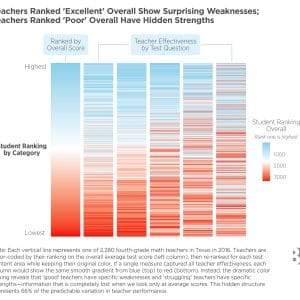


Much of the data collected in education is effectively thrown away. Students answer individual test questions, but administrators and researchers only see aggregate performance. All the item-level data are lost. Ex ante it is not clear this destroys much useful information, since the aggregate might be a sufficient statistic. Using data from Texas for 5 million students and 1.31 billion student-item responses, we show that in fact aggregation does destroy a great deal of valuable information in education: (1) Even conditional on a summary test measure, there is additional information in the item-level data; (2) This additional information is relevant for the student outcomes that education decisions seek to optimize; and (3) This information can be made practically useful for schools. Given how inexpensive storing, transmitting and analyzing such data would be, large gains could be had in education by simply using all the data we currently collect.

More on this topic

BFI Working Paper·Nov 20, 2025

Social Dynamics of AI Adoption

Leonardo Bursztyn, Alex Imas, Rafael Jiménez-Durán, Aaron Leonard, and Christopher Roth
Topics: K-12 Education, Technology & Innovation
BFI Working Paper·May 12, 2025

Separation of Church and State Curricula? Examining Public and Religious Private School Textbooks

Anjali Adukia and Emileigh Harrison
Topics: K-12 Education
BFI Working Paper·May 13, 2024

What Went Wrong with Federal Student Loans?

Adam Looney and Constantine Yannelis
Topics: K-12 Education