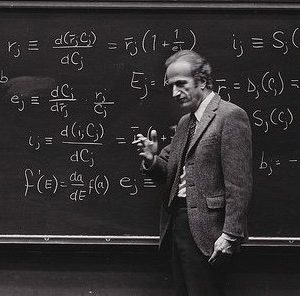
The Becker Friedman Institute for Economics (BFI) serves as a hub for cutting-edge analysis and research across the entire University of Chicago economics community, uniting researchers from the Booth School of Business, the Kenneth C. Griffin Department of Economics, the...
Inspired by our namesakes, Nobel Laureates Gary Becker and Milton Friedman, who believed that economics research could help improve the world, BFI works with the Chicago Economics community to turn its evidence-based research into real-world impact.
The Predoctoral Research in Economics Program (PREP) is intended to serve as a bridge between college and graduate school for students interested in empirical economics. The program offers unique research and professional training opportunities at the University of Chicago.
Expanding Discovery in Economics+ (EDE+) brings together a diverse group of early undergraduate students to hone their research abilities and technical skills.
Patrick Kline, Evan K. Rose, and Christopher Walters
We field and analyze an online survey eliciting beliefs about discrimination and other aspects of recruiting conduct by 164 large firms. Roughly one-third of survey respondents report having put off applying for a job due to fear of discrimination. For...
José-Luis Cruz, Klaus Desmet, and Esteban Rossi-Hansberg
The Atlantic Meridional Overturning Circulation (AMOC) is a system of ocean currents that plays a key role in regulating global climate, including moderating temperatures in Europe and the North Atlantic. Its potential collapse due to global warming is widely considered...
Emotional intelligence constitutes a key component of human capital, shaped partially by educational materials. Using machine learning and generative AI tools, we examine emotional content in public-school textbooks and children’s literature. A stark mismatch emerges: text exposes children to a...
Captivating and informative videos on the latest insights and trends as well as the tested stock of knowledge in economics from leaders in academia, policy, business, and the media.
This paper builds a new model of financial exchange competition, tailored to the institutional details of the modern US stock market. In equilibrium, exchange trading fees are competitive but exchanges are able to earn economic profits from the sale of speed technology. We document stylized facts consistent with these results. We then use the model to analyze incentives for market design innovation. The novel tension between private and social innovation incentives is incumbents’ rents from speed technology in the status quo. This creates a disincentive to adopt new market designs that eliminate latency arbitrage and the high-frequency trading arms race.
The Becker Friedman Institute for Economics (BFI) serves as a hub for cutting-edge analysis and research across the entire University of Chicago economics community, uniting researchers from the Booth School of Business, the Kenneth C. Griffin Department of Economics, the...
Inspired by our namesakes, Nobel Laureates Gary Becker and Milton Friedman, who believed that economics research could help improve the world, BFI works with the Chicago Economics community to turn its evidence-based research into real-world impact.
The Predoctoral Research in Economics Program (PREP) is intended to serve as a bridge between college and graduate school for students interested in empirical economics. The program offers unique research and professional training opportunities at the University of Chicago.
Expanding Discovery in Economics+ (EDE+) brings together a diverse group of early undergraduate students to hone their research abilities and technical skills.
Patrick Kline, Evan K. Rose, and Christopher Walters
We field and analyze an online survey eliciting beliefs about discrimination and other aspects of recruiting conduct by 164 large firms. Roughly one-third of survey respondents report having put off applying for a job due to fear of discrimination. For...
José-Luis Cruz, Klaus Desmet, and Esteban Rossi-Hansberg
The Atlantic Meridional Overturning Circulation (AMOC) is a system of ocean currents that plays a key role in regulating global climate, including moderating temperatures in Europe and the North Atlantic. Its potential collapse due to global warming is widely considered...
Emotional intelligence constitutes a key component of human capital, shaped partially by educational materials. Using machine learning and generative AI tools, we examine emotional content in public-school textbooks and children’s literature. A stark mismatch emerges: text exposes children to a...
Captivating and informative videos on the latest insights and trends as well as the tested stock of knowledge in economics from leaders in academia, policy, business, and the media.