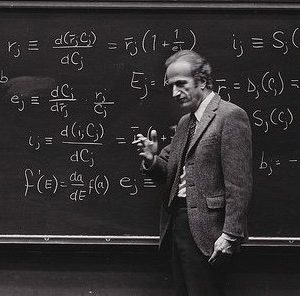
The Becker Friedman Institute for Economics (BFI) serves as a hub for cutting-edge analysis and research across the entire University of Chicago economics community, uniting researchers from the Booth School of Business, the Kenneth C. Griffin Department of Economics, the...
Inspired by our namesakes, Nobel Laureates Gary Becker and Milton Friedman, who believed that economics research could help improve the world, BFI works with the Chicago Economics community to turn its evidence-based research into real-world impact.
The Predoctoral Research in Economics Program (PREP) is intended to serve as a bridge between college and graduate school for students interested in empirical economics. The program offers unique research and professional training opportunities at the University of Chicago.
Expanding Discovery in Economics+ (EDE+) brings together a diverse group of early undergraduate students to hone their research abilities and technical skills.
We examine the role of central bank reserves and public liquidity when secondary markets may freeze. Central bank reserves help intermediaries purchase assets during stress but crowd out investment. Under laissez-faire, intermediaries hold insufficient reserves, overlooking how aggregate liquidity reduces...
Cesar Chavez Padilla, Shuaizhang Feng, James Heckman, and Zhe Yang
Using rich data on Chinese schoolchildren, we study the relationships of IQ and personality traits with children’s risk preferences and how they affect the precision with which those preferences are measured. Our structural model separates preferences from deliberation noise and...
Juanma Castro-Vincenzi, Adry Gracio, Gaurav Khanna, and Nitya Pandalai-Nayar
We study how aggregate risk shapes production, trade, and input sourcing in complex supply chains. We develop a quantitative model of sequential production under risk, where each stage sources inputs from multiple origins. Analytically, we first show that sourcing shares...
Captivating and informative videos on the latest insights and trends as well as the tested stock of knowledge in economics from leaders in academia, policy, business, and the media.
We analyze persuasion in a model, in which each receiver might buy a direct access to the sender’s signal or to rely on her network connections to get it. For the sender, a higher slant increases the impact per direct receiver, yet diminishes the willingness of agents to receive information. Contrary to naive intuition, the optimal propaganda might target peripheral, rather than centrally-located agents, and is at its maximum levels when the probability that information flows between agents is close to zero or nearly one, but not in-between. The impact of the network density depends on this probability as well.
The Becker Friedman Institute for Economics (BFI) serves as a hub for cutting-edge analysis and research across the entire University of Chicago economics community, uniting researchers from the Booth School of Business, the Kenneth C. Griffin Department of Economics, the...
Inspired by our namesakes, Nobel Laureates Gary Becker and Milton Friedman, who believed that economics research could help improve the world, BFI works with the Chicago Economics community to turn its evidence-based research into real-world impact.
The Predoctoral Research in Economics Program (PREP) is intended to serve as a bridge between college and graduate school for students interested in empirical economics. The program offers unique research and professional training opportunities at the University of Chicago.
Expanding Discovery in Economics+ (EDE+) brings together a diverse group of early undergraduate students to hone their research abilities and technical skills.
We examine the role of central bank reserves and public liquidity when secondary markets may freeze. Central bank reserves help intermediaries purchase assets during stress but crowd out investment. Under laissez-faire, intermediaries hold insufficient reserves, overlooking how aggregate liquidity reduces...
Cesar Chavez Padilla, Shuaizhang Feng, James Heckman, and Zhe Yang
Using rich data on Chinese schoolchildren, we study the relationships of IQ and personality traits with children’s risk preferences and how they affect the precision with which those preferences are measured. Our structural model separates preferences from deliberation noise and...
Juanma Castro-Vincenzi, Adry Gracio, Gaurav Khanna, and Nitya Pandalai-Nayar
We study how aggregate risk shapes production, trade, and input sourcing in complex supply chains. We develop a quantitative model of sequential production under risk, where each stage sources inputs from multiple origins. Analytically, we first show that sourcing shares...
Captivating and informative videos on the latest insights and trends as well as the tested stock of knowledge in economics from leaders in academia, policy, business, and the media.