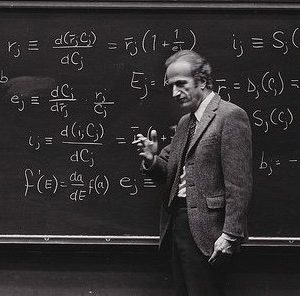
The Becker Friedman Institute for Economics (BFI) serves as a hub for cutting-edge analysis and research across the entire University of Chicago economics community, uniting researchers from the Booth School of Business, the Kenneth C. Griffin Department of Economics, the...
Inspired by our namesakes, Nobel Laureates Gary Becker and Milton Friedman, who believed that economics research could help improve the world, BFI works with the Chicago Economics community to turn its evidence-based research into real-world impact.
The Predoctoral Research in Economics Program (PREP) is intended to serve as a bridge between college and graduate school for students interested in empirical economics. The program offers unique research and professional training opportunities at the University of Chicago.
Expanding Discovery in Economics+ (EDE+) brings together a diverse group of early undergraduate students to hone their research abilities and technical skills.
Policies restricting gun sales face substantial political opposition and constitutional constraints. In this paper, we ask how costly it would be to induce potential handgun buyers to choose less lethal alternatives. Pairing stated-choice experiments with a behavioral model of firearm...
Ran Abramitzky, Jacob Conway, Roy Mill, and Luke C.D. Stein
We study differences in economic outcomes by perceived skin tone among African Americans using full-count U.S. decennial census data from the late-19th and early-20th centuries. Comparing children coded as “Black” or “Mulatto” by census enumerators and linking these children across...
Pablo A. Celhay, Nicolás Figueroa, Carla Guadalupi, and Benjamín Oteíza
Social insurance often relies on third-party gatekeepers to certify eligibility, but planners cannot easily verify whether those certifications are accurate. We study this problem in the market for medical sick leave using the universe of sick leave certificates in Chile...
Captivating and informative videos on the latest insights and trends as well as the tested stock of knowledge in economics from leaders in academia, policy, business, and the media.
We study local carbon policy to address the consequences of climate change. Standard analysis suggests that the social cost of carbon determines optimal carbon policy. We start by using the spatial integrated assessment model in Cruz and Rossi-Hansberg (2021) to measure the local social monetary cost of CO2 emissions: the Local Social Cost of Carbon (LSCC). Although the largest welfare costs from global warming are concentrated in the warmest parts of the developing world, adjusting for the local marginal utility of income implies that the LSCC peaks in warm and high-income regions like the southern parts of the U.S. and Europe, as well as Australia. We then proceed to study the effect of the actual carbon reduction pledges in the Paris Agreement and the progress they can make in implementing the expressed goal of keeping global temperature increases below 2°C. We find that although the distribution of pledges is roughly in line with the LSCC, their magnitude is largely insufficient to achieve its goals. The required carbon taxes necessary to keep temperatures below 2°C over the current century are an order of magnitude higher and involve large implicit inter-temporal transfers. Increasing the elasticity of substitution across energy sources is important to reduce the carbon taxes necessary to achieve warming goals.
The Becker Friedman Institute for Economics (BFI) serves as a hub for cutting-edge analysis and research across the entire University of Chicago economics community, uniting researchers from the Booth School of Business, the Kenneth C. Griffin Department of Economics, the...
Inspired by our namesakes, Nobel Laureates Gary Becker and Milton Friedman, who believed that economics research could help improve the world, BFI works with the Chicago Economics community to turn its evidence-based research into real-world impact.
The Predoctoral Research in Economics Program (PREP) is intended to serve as a bridge between college and graduate school for students interested in empirical economics. The program offers unique research and professional training opportunities at the University of Chicago.
Expanding Discovery in Economics+ (EDE+) brings together a diverse group of early undergraduate students to hone their research abilities and technical skills.
Policies restricting gun sales face substantial political opposition and constitutional constraints. In this paper, we ask how costly it would be to induce potential handgun buyers to choose less lethal alternatives. Pairing stated-choice experiments with a behavioral model of firearm...
Ran Abramitzky, Jacob Conway, Roy Mill, and Luke C.D. Stein
We study differences in economic outcomes by perceived skin tone among African Americans using full-count U.S. decennial census data from the late-19th and early-20th centuries. Comparing children coded as “Black” or “Mulatto” by census enumerators and linking these children across...
Pablo A. Celhay, Nicolás Figueroa, Carla Guadalupi, and Benjamín Oteíza
Social insurance often relies on third-party gatekeepers to certify eligibility, but planners cannot easily verify whether those certifications are accurate. We study this problem in the market for medical sick leave using the universe of sick leave certificates in Chile...
Captivating and informative videos on the latest insights and trends as well as the tested stock of knowledge in economics from leaders in academia, policy, business, and the media.