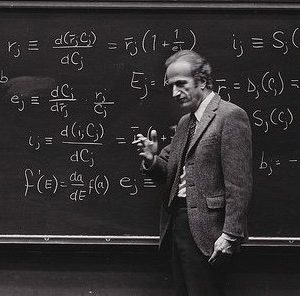
The Becker Friedman Institute for Economics (BFI) serves as a hub for cutting-edge analysis and research across the entire University of Chicago economics community, uniting researchers from the Booth School of Business, the Kenneth C. Griffin Department of Economics, the...
Inspired by our namesakes, Nobel Laureates Gary Becker and Milton Friedman, who believed that economics research could help improve the world, BFI works with the Chicago Economics community to turn its evidence-based research into real-world impact.
The Predoctoral Research in Economics Program (PREP) is intended to serve as a bridge between college and graduate school for students interested in empirical economics. The program offers unique research and professional training opportunities at the University of Chicago.
Expanding Discovery in Economics+ (EDE+) brings together a diverse group of early undergraduate students to hone their research abilities and technical skills.
The classic literature argues that a large middle class is a prerequisite for economic development. Is this true when AI progress threatens to disrupt the labor market? On the one hand, uncertainty about the consequences can impede the passage of...
Hunt Allcott, Amy Finkelstein, Anna Grummon, and Matthew Notowidigdo
As of July 2026, 23 states had approved policies that disallow spending of SNAP benefits on sugary drinks. The effects of such restrictions on consumption are unclear, however, since most households can simply switch to buying sugary drinks with non-SNAP...
Jean-Pierre Dubé, Ilya Morozov, Franklin She, and Anna Tuchman
We study how in-store display ads communicate information about a product’s price and quality, both directly through ad content and indirectly through inferences consumers draw from the presence and content of the ad. We run an incentivized experiment in a...
Captivating and informative videos on the latest insights and trends as well as the tested stock of knowledge in economics from leaders in academia, policy, business, and the media.
We develop an optimal policy assignment rule that integrates two distinctive approaches commonly used in economics—targeting by observables and targeting through self-selection. Our method can be used with experimental or quasi-experimental data to identify who should be treated, be untreated, and self-select to achieve a policymaker’s objective. Applying this method to a randomized controlled trial on a residential energy rebate program, we find that targeting that optimally exploits both observable data and self-selection outperforms conventional targeting for a utilitarian welfare function as well as welfare functions that balance the equity-efficiency tradeoff. We highlight that the Local Average Treatment Effect (LATE) framework (Imbens and Angrist, 1994) can be used to investigate the mechanism behind our approach. By estimating several key LATEs based on the random variation created by our experiment, we demonstrate how our method allows policymakers to identify whose self-selection would be valuable and harmful to social welfare.
The Becker Friedman Institute for Economics (BFI) serves as a hub for cutting-edge analysis and research across the entire University of Chicago economics community, uniting researchers from the Booth School of Business, the Kenneth C. Griffin Department of Economics, the...
Inspired by our namesakes, Nobel Laureates Gary Becker and Milton Friedman, who believed that economics research could help improve the world, BFI works with the Chicago Economics community to turn its evidence-based research into real-world impact.
The Predoctoral Research in Economics Program (PREP) is intended to serve as a bridge between college and graduate school for students interested in empirical economics. The program offers unique research and professional training opportunities at the University of Chicago.
Expanding Discovery in Economics+ (EDE+) brings together a diverse group of early undergraduate students to hone their research abilities and technical skills.
The classic literature argues that a large middle class is a prerequisite for economic development. Is this true when AI progress threatens to disrupt the labor market? On the one hand, uncertainty about the consequences can impede the passage of...
Hunt Allcott, Amy Finkelstein, Anna Grummon, and Matthew Notowidigdo
As of July 2026, 23 states had approved policies that disallow spending of SNAP benefits on sugary drinks. The effects of such restrictions on consumption are unclear, however, since most households can simply switch to buying sugary drinks with non-SNAP...
Jean-Pierre Dubé, Ilya Morozov, Franklin She, and Anna Tuchman
We study how in-store display ads communicate information about a product’s price and quality, both directly through ad content and indirectly through inferences consumers draw from the presence and content of the ad. We run an incentivized experiment in a...
Captivating and informative videos on the latest insights and trends as well as the tested stock of knowledge in economics from leaders in academia, policy, business, and the media.