
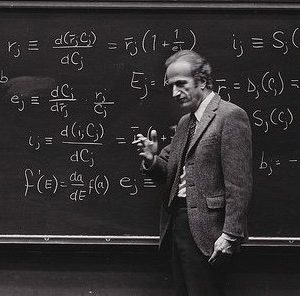
The Becker Friedman Institute for Economics (BFI) serves as a hub for cutting-edge analysis and research across the entire University of Chicago economics community, uniting researchers from the Booth School of Business, the Kenneth C. Griffin Department of Economics, the...
Inspired by our namesakes, Nobel Laureates Gary Becker and Milton Friedman, who believed that economics research could help improve the world, BFI works with the Chicago Economics community to turn its evidence-based research into real-world impact.
The Predoctoral Research in Economics Program (PREP) is intended to serve as a bridge between college and graduate school for students interested in empirical economics. The program offers unique research and professional training opportunities at the University of Chicago.
Expanding Discovery in Economics+ (EDE+) brings together a diverse group of early undergraduate students to hone their research abilities and technical skills.
Patrick Kline, Evan K. Rose, and Christopher Walters
We field and analyze an online survey eliciting beliefs about discrimination and other aspects of recruiting conduct by 164 large firms. Roughly one-third of survey respondents report having put off applying for a job due to fear of discrimination. For...
José-Luis Cruz, Klaus Desmet, and Esteban Rossi-Hansberg
The Atlantic Meridional Overturning Circulation (AMOC) is a system of ocean currents that plays a key role in regulating global climate, including moderating temperatures in Europe and the North Atlantic. Its potential collapse due to global warming is widely considered...
Emotional intelligence constitutes a key component of human capital, shaped partially by educational materials. Using machine learning and generative AI tools, we examine emotional content in public-school textbooks and children’s literature. A stark mismatch emerges: text exposes children to a...
Captivating and informative videos on the latest insights and trends as well as the tested stock of knowledge in economics from leaders in academia, policy, business, and the media.
The University of Chicago's Examination of the Foundation, Frontier, and Future of Economics
Marking the 250th anniversary of Adam Smith's The Wealth of Nations—the book that launched modern economics.
About
What causes the wealth of nations?
In 1776, Adam Smith launched modern economics and changed the world by asking this seemingly simple question. Today, 250 years later, the University of Chicago Becker Friedman Institute for Economics marks this anniversary with Wealth250 — a yearlong examination of the foundation, frontier, and future of economics. UChicago scholars and global leaders are coming together to explore what we have learned across this quarter millennium and identify what questions lie ahead.
The event is part of BFI’s year-long series celebrating the 250th anniversary of Adam Smith’s The Wealth of Nations and will focus on the Federal Reserve, inflation, and monetary policy
With Pie Day right around the corner, BFI is celebrating with pizza, prizes, and a nod to the foundation of economics. Join fellow students for a casual lunch celebrating the 250th anniversary of Adam Smith’s The Wealth of Nations.
Featuring Brent Neiman, Edward Eagle Brown Professor of Economics and William Ladany Faculty Scholar, Chicago Booth; Co-Director of BFI's International Economics and Economic Geography Initiative
Featuring Yueran Ma, Carhart Family Professor of Finance at the University of Chicago Booth School Business, and Co-Director of the Fama-Miller Center for Research in Finance
Most people associate Adam Smith with free markets and “the invisible hand”. But does this conventional narrative purposefully ignore Smith’s deep suspicions about monopolies and power?
As we approach the 250th anniversary of Adam Smith's “Wealth of Nations" this March, his theories on competition and the invisible hand remain part of the bedrock of modern economics. But, have we undermined those theories in our economy today?
Nearly 250 years later, BFI researchers continue to ask the same questions Smith raised, now with new data, new methods, and new economies to study. The highlighted research below is organized around the topics Smith raised across The Wealth of Nations, showing how his core inquiries remain alive in contemporary economic research.
The Becker Friedman Institute for Economics (BFI) serves as a hub for cutting-edge analysis and research across the entire University of Chicago economics community, uniting researchers from the Booth School of Business, the Kenneth C. Griffin Department of Economics, the...
Inspired by our namesakes, Nobel Laureates Gary Becker and Milton Friedman, who believed that economics research could help improve the world, BFI works with the Chicago Economics community to turn its evidence-based research into real-world impact.
The Predoctoral Research in Economics Program (PREP) is intended to serve as a bridge between college and graduate school for students interested in empirical economics. The program offers unique research and professional training opportunities at the University of Chicago.
Expanding Discovery in Economics+ (EDE+) brings together a diverse group of early undergraduate students to hone their research abilities and technical skills.
Patrick Kline, Evan K. Rose, and Christopher Walters
We field and analyze an online survey eliciting beliefs about discrimination and other aspects of recruiting conduct by 164 large firms. Roughly one-third of survey respondents report having put off applying for a job due to fear of discrimination. For...
José-Luis Cruz, Klaus Desmet, and Esteban Rossi-Hansberg
The Atlantic Meridional Overturning Circulation (AMOC) is a system of ocean currents that plays a key role in regulating global climate, including moderating temperatures in Europe and the North Atlantic. Its potential collapse due to global warming is widely considered...
Emotional intelligence constitutes a key component of human capital, shaped partially by educational materials. Using machine learning and generative AI tools, we examine emotional content in public-school textbooks and children’s literature. A stark mismatch emerges: text exposes children to a...
Captivating and informative videos on the latest insights and trends as well as the tested stock of knowledge in economics from leaders in academia, policy, business, and the media.