




The sharp COVID-19 recession during early 2020 inspired the largest-ever fiscal stimulus enacted by US policymakers. The stimulus took many forms, including Paycheck Protection Program loans and other business support totaling $1.7 trillion, aid to state and local governments totaling $745 billion, and support for households such as expanded unemployment benefits, the expanded Child Tax Credit, and three rounds of stimulus checks, all totaling $1.8 trillion. Researchers and politicians have criticized the large payments to households out of concern that they contributed to the inflation that emerged in 2021.
In this paper, the authors test how much the pandemic-era stimulus drove household demand, as well as how much it contributed to inflation. They study these questions in the context of the auto market, where they are able to observe both car purchases and car prices using administrative data from vehicle registrations.
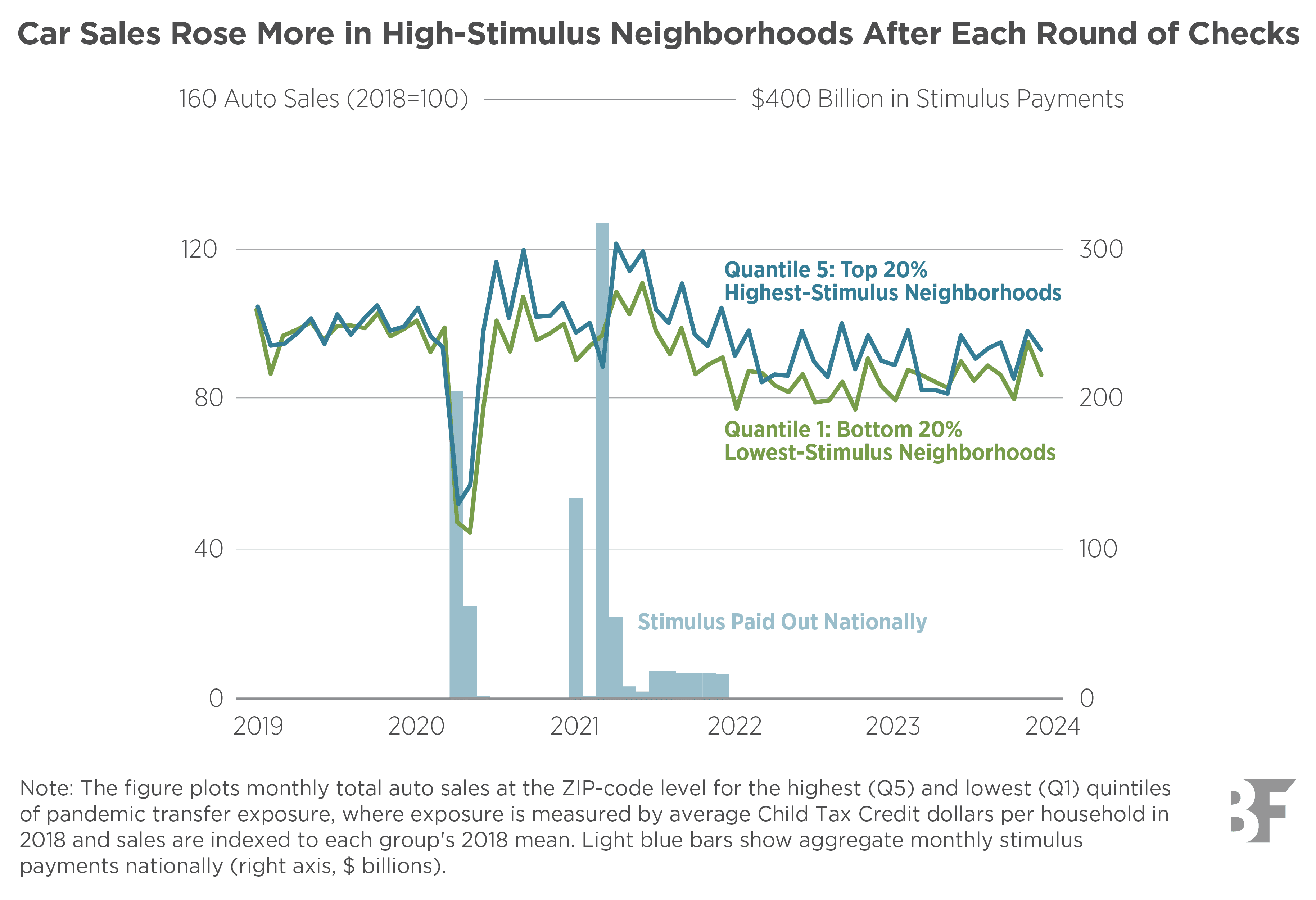
The authors begin their analysis by measuring how stimulus impacted car purchases. They compare vehicle sales between neighborhoods that received more versus less fiscal stimulus during the pandemic (stimulus amount depended on family structure, and some neighborhoods received far more checks than others). They attribute increased sales in the months after payment to the causal effect of the cash stimulus, and find the following:
- Stimulus increased auto sales by 5.5 million vehicles (3.2%) over 2020–2022. The gains were larger for new vehicles (4.2%) than used (2.9%), and they persisted without reversal after the payments ended.
- Households spent a substantial share of the stimulus they received. Over three years, about 19 cents of every dollar received went toward cars, and roughly 47 cents toward purchases more broadly.
The authors next turn to prices, asking whether increased consumption caused the rise in car prices observed during the pandemic. To study this question, they use economic models to translate the sales response documented above into an implied effect on prices, as well as to test the role of other forces like supply shortages and easier credit. They find the following:
- The stimulus accounts for less than 20% of the pandemic-era rise in car prices, and under the authors’ preferred model, only about 3%. The rest is attributable to other forces: roughly 21% from other (non-fiscal) demand shocks and 75% from supply shocks.
- Secondary markets appear to dampen price pressure. As stimulus recipients buy new cars and trade in their old ones, used supply expands. In the authors’ baseline model, where new-car supply can respond, stimulus alone pushes used-car prices down through this channel.
- The same stimulus mostly raises auto sales when vehicle supply is flexible, but shows up more as higher prices when supply is tight. In other words, whether stimulus causes mainly increased sales or mainly inflation depends on how much supply can respond.
- Targeting stimulus to lower-wealth, credit-constrained households produces a larger boost to auto demand than targeting wealthier households, because lower-wealth households spend a greater share of the transfer. In addition, because these households typically buy used cars, their extra demand lands in the used market and generate the largest sales gains when supply can respond, and the largest price increases when supply is tight.
These findings carry implications for policy. They suggest that the inflationary impact of stimulus depends not just on the size of the transfers, but on supply conditions, market structure, and which households receive the money. More broadly, accounting for the role of secondary markets is important for understanding the effects of fiscal policy, since they can absorb demand and dampen the price pressure that transfers would otherwise create.