The Becker Friedman Institute for Economics (BFI) serves as a hub for cutting-edge analysis and research across the entire University of Chicago economics community, uniting researchers from the Booth School of Business, the Kenneth C. Griffin Department of Economics, the...
Inspired by our namesakes, Nobel Laureates Gary Becker and Milton Friedman, who believed that economics research could help improve the world, BFI works with the Chicago Economics community to turn its evidence-based research into real-world impact.
The Predoctoral Research in Economics Program (PREP) is intended to serve as a bridge between college and graduate school for students interested in empirical economics. The program offers unique research and professional training opportunities at the University of Chicago.
Expanding Discovery in Economics+ (EDE+) brings together a diverse group of early undergraduate students to hone their research abilities and technical skills.
Anna Chorniy, Amy Finkelstein, and Matthew Notowidigdo
We estimate and compare impacts of cash and in-kind transfers on the consumption of temptation goods in the same population, and explore normative implications. We use two decades of data from South Carolina on cash benefits from Supplemental Security Income...
Leonardo Bursztyn, Alex Imas, Rafael Jiménez-Durán, Aaron Leonard, and Christopher Roth
Anxiety about falling behind can drive people to embrace emerging technologies with uncertain consequences. We study how social forces shape demand for AI-based learning tools early in the education pipeline. In incentivized experiments with parents—key gatekeepers for children’s AI adoption—we...
Jesse Bruhn, Michael Gilraine, Jens Ludwig, and Sendhil Mullainathan
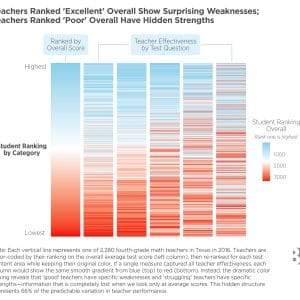
Much of the data collected in education is effectively thrown away. Students answer individual test questions, but administrators and researchers only see aggregate performance. All the item-level data are lost. Ex ante it is not clear this destroys much useful...
Captivating and informative videos on the latest insights and trends as well as the tested stock of knowledge in economics from leaders in academia, policy, business, and the media.
Curricula impart knowledge, instill values, and shape collective memory. Despite growing public funding for religious schools through U.S. school choice programs, little is known about what they teach. We examine textbooks from public schools, religious private schools, and home schools, applying computational methods–including AI tools–to measure the presence and portrayal of people, topics, and values over time. Despite narratives of political polarization, our findings reveal few meaningful differences between public school textbooks from Texas and California. However, religious school textbooks have less female representation, feature lighter-skinned individuals, and portray topics like evolution and religion differently. Over one-third of pages in each collection convey character values, with a higher proportion in religious school textbooks. Important similarities also emerge: all textbook collections rarely include LGBTQIA+ discussion, portray females in more positive but less active or powerful contexts than males, and depict the U.S. founding era and slavery in similar contexts.
The Becker Friedman Institute for Economics (BFI) serves as a hub for cutting-edge analysis and research across the entire University of Chicago economics community, uniting researchers from the Booth School of Business, the Kenneth C. Griffin Department of Economics, the...
Inspired by our namesakes, Nobel Laureates Gary Becker and Milton Friedman, who believed that economics research could help improve the world, BFI works with the Chicago Economics community to turn its evidence-based research into real-world impact.
The Predoctoral Research in Economics Program (PREP) is intended to serve as a bridge between college and graduate school for students interested in empirical economics. The program offers unique research and professional training opportunities at the University of Chicago.
Expanding Discovery in Economics+ (EDE+) brings together a diverse group of early undergraduate students to hone their research abilities and technical skills.
Anna Chorniy, Amy Finkelstein, and Matthew Notowidigdo
We estimate and compare impacts of cash and in-kind transfers on the consumption of temptation goods in the same population, and explore normative implications. We use two decades of data from South Carolina on cash benefits from Supplemental Security Income...
Leonardo Bursztyn, Alex Imas, Rafael Jiménez-Durán, Aaron Leonard, and Christopher Roth
Anxiety about falling behind can drive people to embrace emerging technologies with uncertain consequences. We study how social forces shape demand for AI-based learning tools early in the education pipeline. In incentivized experiments with parents—key gatekeepers for children’s AI adoption—we...
Jesse Bruhn, Michael Gilraine, Jens Ludwig, and Sendhil Mullainathan
Much of the data collected in education is effectively thrown away. Students answer individual test questions, but administrators and researchers only see aggregate performance. All the item-level data are lost. Ex ante it is not clear this destroys much useful...
Captivating and informative videos on the latest insights and trends as well as the tested stock of knowledge in economics from leaders in academia, policy, business, and the media.