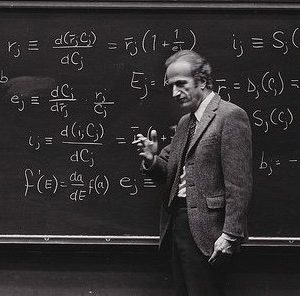
The Becker Friedman Institute for Economics (BFI) serves as a hub for cutting-edge analysis and research across the entire University of Chicago economics community, uniting researchers from the Booth School of Business, the Kenneth C. Griffin Department of Economics, the...
Inspired by our namesakes, Nobel Laureates Gary Becker and Milton Friedman, who believed that economics research could help improve the world, BFI works with the Chicago Economics community to turn its evidence-based research into real-world impact.
The Predoctoral Research in Economics Program (PREP) is intended to serve as a bridge between college and graduate school for students interested in empirical economics. The program offers unique research and professional training opportunities at the University of Chicago.
Expanding Discovery in Economics+ (EDE+) brings together a diverse group of early undergraduate students to hone their research abilities and technical skills.
Lubos Pastor, Robert F. Stambaugh, and Lucian A. Taylor
We study how opening private markets to retail investors affects investors and firms. Calibrating a production-based asset-pricing model, we find that democratization raises retail investors’ welfare, but barely. Retail investors benefit little from democratization even if they face no extra...
Bruce Meyer, Nikolas Mittag, Derek Wu, Anthony Tatarka, and Patrick Langetieg
Surveys provide much of what we know in social science and are often the only source of information on private behaviors, attitudes and expectations. Strands of the literature document four broad error sources: survey coverage, unit non-response, item non-response, and...
Artificial intelligence is increasingly used for political advice. We study an AI that is better informed about a payoff-relevant state and cares both about accuracy and about the perceived welfare of the individual it advises. The AI then has an...
Captivating and informative videos on the latest insights and trends as well as the tested stock of knowledge in economics from leaders in academia, policy, business, and the media.
The Becker Friedman Institute for Economics (BFI) serves as a hub for cutting-edge analysis and research across the entire University of Chicago economics community, uniting researchers from the Booth School of Business, the Kenneth C. Griffin Department of Economics, the...
Inspired by our namesakes, Nobel Laureates Gary Becker and Milton Friedman, who believed that economics research could help improve the world, BFI works with the Chicago Economics community to turn its evidence-based research into real-world impact.
The Predoctoral Research in Economics Program (PREP) is intended to serve as a bridge between college and graduate school for students interested in empirical economics. The program offers unique research and professional training opportunities at the University of Chicago.
Expanding Discovery in Economics+ (EDE+) brings together a diverse group of early undergraduate students to hone their research abilities and technical skills.
Lubos Pastor, Robert F. Stambaugh, and Lucian A. Taylor
We study how opening private markets to retail investors affects investors and firms. Calibrating a production-based asset-pricing model, we find that democratization raises retail investors’ welfare, but barely. Retail investors benefit little from democratization even if they face no extra...
Bruce Meyer, Nikolas Mittag, Derek Wu, Anthony Tatarka, and Patrick Langetieg
Surveys provide much of what we know in social science and are often the only source of information on private behaviors, attitudes and expectations. Strands of the literature document four broad error sources: survey coverage, unit non-response, item non-response, and...
Artificial intelligence is increasingly used for political advice. We study an AI that is better informed about a payoff-relevant state and cares both about accuracy and about the perceived welfare of the individual it advises. The AI then has an...
Captivating and informative videos on the latest insights and trends as well as the tested stock of knowledge in economics from leaders in academia, policy, business, and the media.