




As students, parents, and schools grapple in real time with the presence of artificial intelligence (AI) in classrooms, one powerful incentive is driving its use by students: parents’ fear that their children will fall behind because other children are using AI. This fear of falling behind outweighs the considerable uncertainty surrounding the effects of AI on students, who may benefit from AI in the short run but who may also suffer long-run negative effects on their cognitive development and human capital outcomes.
This drive for short-run gains at the risk of long-run costs can result in what the authors call rat race dynamics that drive the unrestricted adoption of new technologies. (This notion is akin to time consistency: the problem of time consistency looms large for policymakers. A time consistent policy is one where future a policymaker cannot act on an incentive to revoke a previously established policy. On the other hand, a policy that lacks time consistency would offer a future policymaker both the incentive and the means to break a policy commitment. The economists Fynn E. Kydland and Edward C. Prescott were awarded the Sveriges Riksbank Prize in Economic Sciences in Memory of Alfred Nobel in 2004 in part for their formative work on time consistency in economic policy. Their 1977 paper, “Rules Rather Than Discretion: The Inconsistency of Optimal Plans,” was hugely influential in monetary policymaking. In his Nobel lecture, Prescott cited the work of UChicago economist and Nobel Laureate, Robert Lucas, as especially important in the development of their ideas. See here for a useful primer on time consistency. in policymaking.) To understand this short vs. long run tradeoff, the authors ask a key question: Do parental decisions to adopt educational AI tools for their kids reflect informed judgments about their potential risks for human capital formation, or are they primarily driven by social factors and anxiety about their children falling behind their peers?
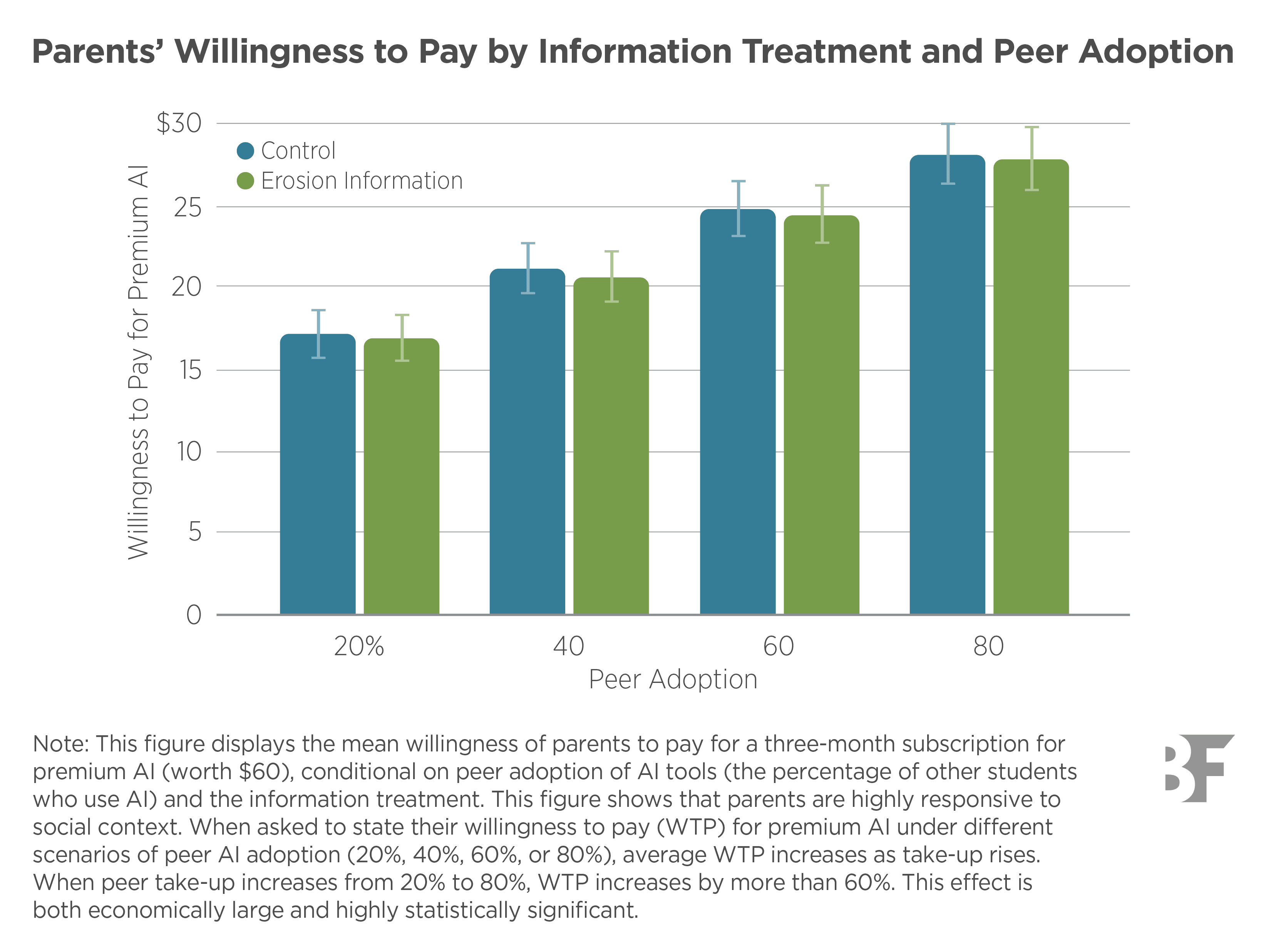
To answer this question, the authors investigate the adoption of AI tools through incentivized, pre-registered experiments involving more than 2,000 parents of teenagers from the United States, Canada, and the United Kingdom. The authors measure parental demand for advanced AI tools by eliciting parents’ willingness to pay (WTP) for a three-month subscription to a premium unrestricted AI education plan. This allows them to study how adoption rates among teenagers’ peers influence parental demand, and to show how beliefs about AI’s impact on cognitive skills shape demand for advanced AI tools. Further, by randomly assigning parents to either a control group receiving information emphasizing AI’s short-run educational benefits, or a treatment group that additionally highlights potential long-run risks, they provide key insight into this technological rat race. They find the following:
- Parents’ WTP for AI tools increases by more than 60% as the proportion of their children’s peers who use AI increases from 20% to 80%. (See accompanying figure.)
- While information about the potential long-run AI-risk leads to a large negative shift in incentivized beliefs about the effects of AI on cognitive skills, such information does little to curb demand; that is, parents are still largely affected by teenage peer adoption.
- Consistent with rat race dynamics, information about long-run harm increases parents’ preference for banning AI in education for all students.
- Finally, the authors provide further evidence for these findings by revealing that a substantial portion of parents who support an AI ban still justify allowing their child to use AI due to fears of them falling behind.
What I think that you think can shape my actions
UChicago economist Leonardo Bursztyn, one of the authors of this paper, has co-authored related work on the social dynamics of decision-making. This new paper provides insights into how the fear of falling behind motivates parents to take actions in line with other parents’ choices. In previous work, Bursztyn et al. provide insights into how the perceived ideas of others can affect the choices/actions that people take. Bursztyn’s paper, “Misperceptions About Others,” reveals that misperceptions about others’ views are widespread, that these misperceptions are disproportionately concentrated on one side relative to the truth, that these misperceptions are exaggerated when they pertain to “outsiders,” that people tend to think that “insiders” believe as they do.
In another paper, “Misperceived Social Norms: Female Labor Force Participation in Saudi Arabia,” Bursztyn et al. show how misperceptions about others restrict women’s ability to work outside the home. By custom, Saudi men decide whether women in their families work outside the home, and privately, most men believe that women should be allowed to work. Those men, though, also think that other men do not share their views, so they are disinclined to allow women in their families to join the labor force. However, the authors show that when men are informed that other men agree on women and work, then those men are more open to the idea.
These findings confirm the authors’ rat race hypothesis: peer adoption ignites parental anxiety about falling behind, which accelerates more adoption despite potential long-term drawbacks. The rat race persists. Further, the incentives driving the rat race are so strong that individual level policy interventions are likely insufficient. Rather, to achieve socially optimal outcomes, educators, parents, and school boards could act in a coordinated fashion to employ AI tools.
These lessons apply beyond education. There is a global rat race to employ AI among firms, countries, and institutions, and fear of falling behind may risk long-run costs that far outweigh short-run gains. For example, rat race dynamics could generate over-investment in AI technology such as data centers as the fear of falling behind leads firm to invest even if the individual investment is unprofitable. Collectively, this is how investment bubbles form. Understanding how rat race dynamics interact with systemic technological change is imperative if we hope to manage the complex trade-offs between short-run gains and long-run consequences.