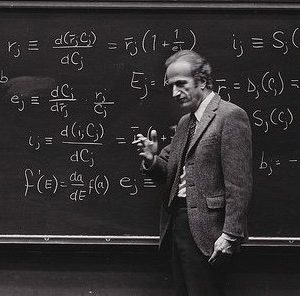
The Becker Friedman Institute for Economics (BFI) serves as a hub for cutting-edge analysis and research across the entire University of Chicago economics community, uniting researchers from the Booth School of Business, the Kenneth C. Griffin Department of Economics, the...
Inspired by our namesakes, Nobel Laureates Gary Becker and Milton Friedman, who believed that economics research could help improve the world, BFI works with the Chicago Economics community to turn its evidence-based research into real-world impact.
The Predoctoral Research in Economics Program (PREP) is intended to serve as a bridge between college and graduate school for students interested in empirical economics. The program offers unique research and professional training opportunities at the University of Chicago.
Expanding Discovery in Economics+ (EDE+) brings together a diverse group of early undergraduate students to hone their research abilities and technical skills.
Policies restricting gun sales face substantial political opposition and constitutional constraints. In this paper, we ask how costly it would be to induce potential handgun buyers to choose less lethal alternatives. Pairing stated-choice experiments with a behavioral model of firearm...
Ran Abramitzky, Jacob Conway, Roy Mill, and Luke C.D. Stein
We study differences in economic outcomes by perceived skin tone among African Americans using full-count U.S. decennial census data from the late-19th and early-20th centuries. Comparing children coded as “Black” or “Mulatto” by census enumerators and linking these children across...
Pablo A. Celhay, Nicolás Figueroa, Carla Guadalupi, and Benjamín Oteíza
Social insurance often relies on third-party gatekeepers to certify eligibility, but planners cannot easily verify whether those certifications are accurate. We study this problem in the market for medical sick leave using the universe of sick leave certificates in Chile...
Captivating and informative videos on the latest insights and trends as well as the tested stock of knowledge in economics from leaders in academia, policy, business, and the media.
Jason Allen, Ali Hortaçsu, Eric Richert, and Milena Wittwer
Hedge funds have become increasingly active in Treasury markets, yet we have little evidence on how this shift has affected the market. We focus on the primary market, where the government issues its debt through auctions. Using over 20 years of data from Canadian Treasury auctions, we document dealers exiting and hedge funds entering. To evaluate the costs and benefits of this trend for debt issuance, we develop an auction framework with endogenous participation. We find that the expected gains from greater hedge fund participation, driven by increased competition, are smaller than the costs that arise because hedge funds—unlike dealers—do not participate regularly. Currently, dealer participation remains sufficiently strong that policies aimed at stabilizing participation have little effect on funding costs.
The Becker Friedman Institute for Economics (BFI) serves as a hub for cutting-edge analysis and research across the entire University of Chicago economics community, uniting researchers from the Booth School of Business, the Kenneth C. Griffin Department of Economics, the...
Inspired by our namesakes, Nobel Laureates Gary Becker and Milton Friedman, who believed that economics research could help improve the world, BFI works with the Chicago Economics community to turn its evidence-based research into real-world impact.
The Predoctoral Research in Economics Program (PREP) is intended to serve as a bridge between college and graduate school for students interested in empirical economics. The program offers unique research and professional training opportunities at the University of Chicago.
Expanding Discovery in Economics+ (EDE+) brings together a diverse group of early undergraduate students to hone their research abilities and technical skills.
Policies restricting gun sales face substantial political opposition and constitutional constraints. In this paper, we ask how costly it would be to induce potential handgun buyers to choose less lethal alternatives. Pairing stated-choice experiments with a behavioral model of firearm...
Ran Abramitzky, Jacob Conway, Roy Mill, and Luke C.D. Stein
We study differences in economic outcomes by perceived skin tone among African Americans using full-count U.S. decennial census data from the late-19th and early-20th centuries. Comparing children coded as “Black” or “Mulatto” by census enumerators and linking these children across...
Pablo A. Celhay, Nicolás Figueroa, Carla Guadalupi, and Benjamín Oteíza
Social insurance often relies on third-party gatekeepers to certify eligibility, but planners cannot easily verify whether those certifications are accurate. We study this problem in the market for medical sick leave using the universe of sick leave certificates in Chile...
Captivating and informative videos on the latest insights and trends as well as the tested stock of knowledge in economics from leaders in academia, policy, business, and the media.