




Many readers have likely imposed self-styled bans on certain retailers, or otherwise joined organized boycotts, based on a firm’s particular social stance. On the other hand, they may also have increased their spending at a retailer whose stance aligns with their own. This behavior raises questions as to the degree that consumers incentivize firm behavior, and whether a firm’s stance-taking is consistent with traditional profit-maximization motives.
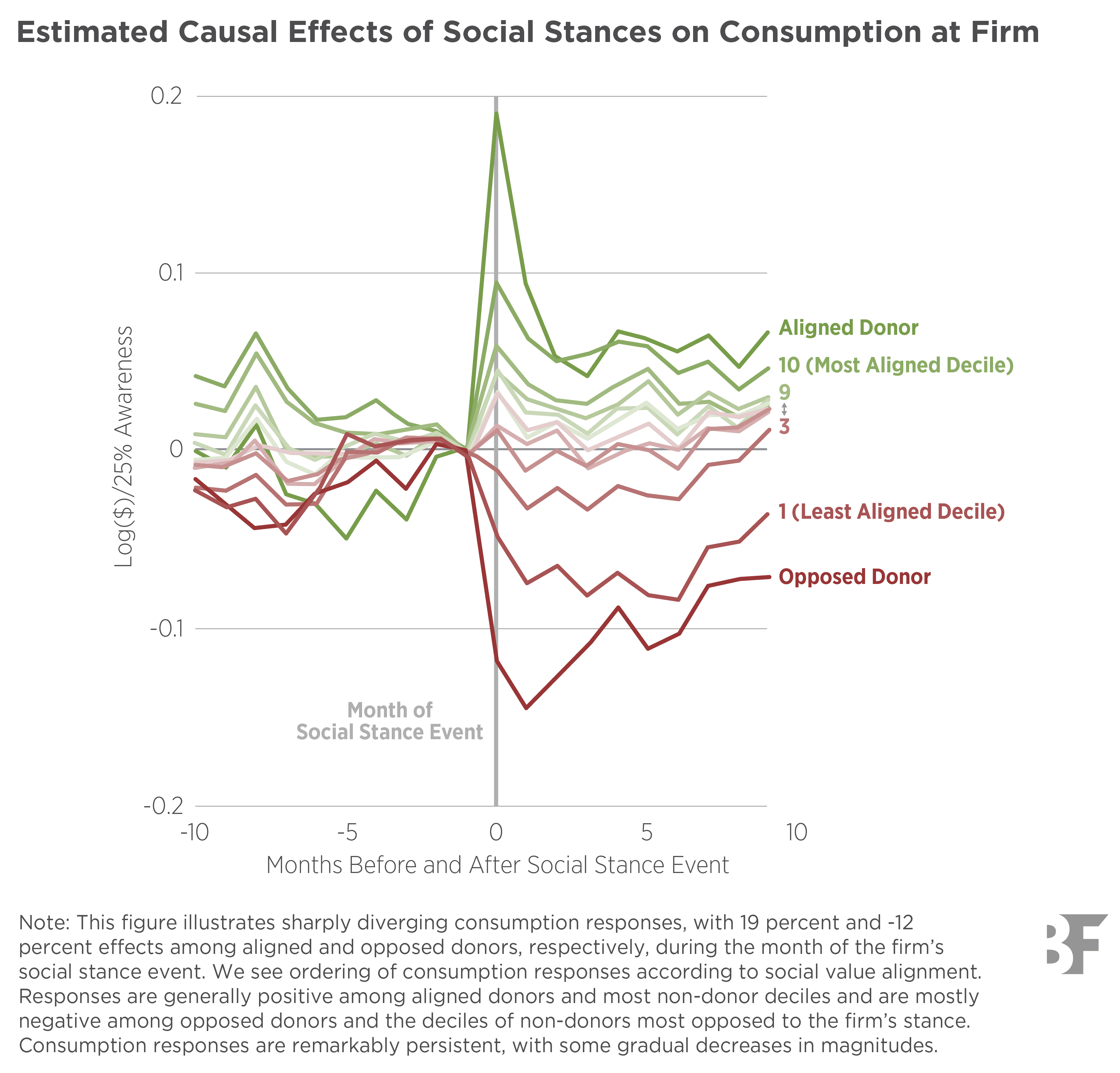
However, how much of this consumer stance-taking shows up at the checkout line, and how much is just “cheap talk?” This paper investigates whether and how consumers change their spending based on a company’s public stance on controversial social issues, and what that means for companies that are considering whether to take such stances.
To study this, the researchers build a dataset of 116 high-profile instances of companies taking controversial social positions, on issues like racial justice, reproductive rights, and LGBTQ+ legislation, and tracked consumer spending responses using transaction data from a major payment card network covering roughly 20% of US consumer spending. To estimate what spending would have looked like without each stance, they compared each company’s sales against thousands of other firms as a benchmark. Regarding consumer response, the authors find the following:
- A highly publicized stance, or one that 25% of surveyed consumers said they had heard about, increased the company’s revenues by about 3% in the month following the event.
- Beneath that average, though, responses were sharply divided: consumers whose views aligned with the company’s stance increased their spending by about 19%, while those who opposed it cut their spending by about 12%. These effects faded over time but remained detectable a year later.
On the company side, the authors find that:
- There is one key factor that determines whether a stance helps or hurts revenue: the social makeup of a firm’s existing customer base, which means that a stance that benefits one company’s bottom line may harm another’s.
- Companies also tend to take stances that match the views of their consumers and their employees, and public versus private ownership can also shape the direction of a firm’s stance.
- Finally, board composition, by contrast, is not a strong predictor of stance direction.
Bottom line: Consumer responses to corporate social stances are not just empty words but rather are genuine and financially meaningful. However, the impact varies considerably across companies and events, depending largely on how well a given stance aligns with the views of a firm’s customers.