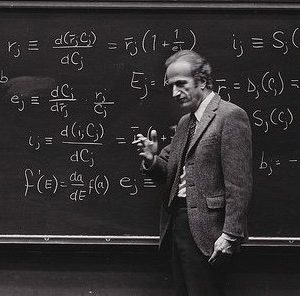
The Becker Friedman Institute for Economics (BFI) serves as a hub for cutting-edge analysis and research across the entire University of Chicago economics community, uniting researchers from the Booth School of Business, the Kenneth C. Griffin Department of Economics, the...
Inspired by our namesakes, Nobel Laureates Gary Becker and Milton Friedman, who believed that economics research could help improve the world, BFI works with the Chicago Economics community to turn its evidence-based research into real-world impact.
The Predoctoral Research in Economics Program (PREP) is intended to serve as a bridge between college and graduate school for students interested in empirical economics. The program offers unique research and professional training opportunities at the University of Chicago.
Expanding Discovery in Economics+ (EDE+) brings together a diverse group of early undergraduate students to hone their research abilities and technical skills.
Deniz Dutz, Magne Mogstad, Morten Håvarstein, and Alexander Torgovitsky
We study the identification of labor supply elasticities from kinked budget sets in a model with income effects and individual heterogeneity in the elasticities. We provide point and partial identification results for compensated elasticities, uncompensated elasticities, and income effects. We...
Aaron L. Bodoh-Creed, Brent R. Hickman, John List, Ian Muir, and Gregory K. Sun
Nonlinear pricing theory predicts that firms can extract surplus by inducing heterogeneous consumers to self-sort across price contract offers that are ex-post optimal for them. We study subscription pricing when the frictionless sorting assumption fails. Using large-scale subscription experiments conducted...
As stock market concentration has risen, regulatory limits on fund portfolio concentration have become increasingly binding, especially for large-cap growth funds. When funds approach these limits, they trim their largest holdings and reduce equity exposure. Funds perform worse when constrained....
Captivating and informative videos on the latest insights and trends as well as the tested stock of knowledge in economics from leaders in academia, policy, business, and the media.
Travers Barclay Child, Kai Gehring, Sarah Langlotz, Austin Wright, and Rossella De Sabbata
This paper leverages granular survey data from within the conflict theater of Afghanistan to investigate how plausibly exogenous exposure to Islamic State (IS) propaganda influences views towards local and international forces. We study two mediums of terrorist propaganda, exploiting high-frequency time variation in global distribution of IS videos and plausibly exogenous signal penetration of a prominent IS radio tower in Afghanistan. Our findings suggest violent video and radio content undermines public support for IS and its key opponents, while increasing demand for international forces to remain in country. By contrast, videos depicting a capacity for IS governance boost their support.
The Becker Friedman Institute for Economics (BFI) serves as a hub for cutting-edge analysis and research across the entire University of Chicago economics community, uniting researchers from the Booth School of Business, the Kenneth C. Griffin Department of Economics, the...
Inspired by our namesakes, Nobel Laureates Gary Becker and Milton Friedman, who believed that economics research could help improve the world, BFI works with the Chicago Economics community to turn its evidence-based research into real-world impact.
The Predoctoral Research in Economics Program (PREP) is intended to serve as a bridge between college and graduate school for students interested in empirical economics. The program offers unique research and professional training opportunities at the University of Chicago.
Expanding Discovery in Economics+ (EDE+) brings together a diverse group of early undergraduate students to hone their research abilities and technical skills.
Deniz Dutz, Magne Mogstad, Morten Håvarstein, and Alexander Torgovitsky
We study the identification of labor supply elasticities from kinked budget sets in a model with income effects and individual heterogeneity in the elasticities. We provide point and partial identification results for compensated elasticities, uncompensated elasticities, and income effects. We...
Aaron L. Bodoh-Creed, Brent R. Hickman, John List, Ian Muir, and Gregory K. Sun
Nonlinear pricing theory predicts that firms can extract surplus by inducing heterogeneous consumers to self-sort across price contract offers that are ex-post optimal for them. We study subscription pricing when the frictionless sorting assumption fails. Using large-scale subscription experiments conducted...
As stock market concentration has risen, regulatory limits on fund portfolio concentration have become increasingly binding, especially for large-cap growth funds. When funds approach these limits, they trim their largest holdings and reduce equity exposure. Funds perform worse when constrained....
Captivating and informative videos on the latest insights and trends as well as the tested stock of knowledge in economics from leaders in academia, policy, business, and the media.