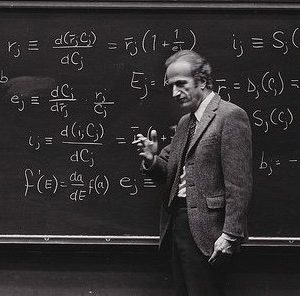
The Becker Friedman Institute for Economics (BFI) serves as a hub for cutting-edge analysis and research across the entire University of Chicago economics community, uniting researchers from the Booth School of Business, the Kenneth C. Griffin Department of Economics, the...
Inspired by our namesakes, Nobel Laureates Gary Becker and Milton Friedman, who believed that economics research could help improve the world, BFI works with the Chicago Economics community to turn its evidence-based research into real-world impact.
The Predoctoral Research in Economics Program (PREP) is intended to serve as a bridge between college and graduate school for students interested in empirical economics. The program offers unique research and professional training opportunities at the University of Chicago.
Expanding Discovery in Economics+ (EDE+) brings together a diverse group of early undergraduate students to hone their research abilities and technical skills.
John List, Matthias Rodemeier, Sutanuka Roy, and Gregory K. Sun
Behavioral interventions have become central to modern public policy, but their empirical promise remains contested because estimated treatment effects often appear small. We argue that a policy response is economically meaningful only relative to the response generated by alternative policies....
Consider a referee report containing the sentence: “Assignment to treatment was voluntary, though the authors acknowledge this as a limitation in the conclusion.” The Editor would summarily reject. Now replace “assignment to treatment” with “entry into the experimental sample,” and...
We examine the role of central bank reserves and public liquidity when secondary markets may freeze. Central bank reserves help intermediaries purchase assets during stress but crowd out investment. Under laissez-faire, intermediaries hold insufficient reserves, overlooking how aggregate liquidity reduces...
Captivating and informative videos on the latest insights and trends as well as the tested stock of knowledge in economics from leaders in academia, policy, business, and the media.
The Becker Friedman Institute for Economics (BFI) serves as a hub for cutting-edge analysis and research across the entire University of Chicago economics community, uniting researchers from the Booth School of Business, the Kenneth C. Griffin Department of Economics, the...
Inspired by our namesakes, Nobel Laureates Gary Becker and Milton Friedman, who believed that economics research could help improve the world, BFI works with the Chicago Economics community to turn its evidence-based research into real-world impact.
The Predoctoral Research in Economics Program (PREP) is intended to serve as a bridge between college and graduate school for students interested in empirical economics. The program offers unique research and professional training opportunities at the University of Chicago.
Expanding Discovery in Economics+ (EDE+) brings together a diverse group of early undergraduate students to hone their research abilities and technical skills.
John List, Matthias Rodemeier, Sutanuka Roy, and Gregory K. Sun
Behavioral interventions have become central to modern public policy, but their empirical promise remains contested because estimated treatment effects often appear small. We argue that a policy response is economically meaningful only relative to the response generated by alternative policies....
Consider a referee report containing the sentence: “Assignment to treatment was voluntary, though the authors acknowledge this as a limitation in the conclusion.” The Editor would summarily reject. Now replace “assignment to treatment” with “entry into the experimental sample,” and...
We examine the role of central bank reserves and public liquidity when secondary markets may freeze. Central bank reserves help intermediaries purchase assets during stress but crowd out investment. Under laissez-faire, intermediaries hold insufficient reserves, overlooking how aggregate liquidity reduces...
Captivating and informative videos on the latest insights and trends as well as the tested stock of knowledge in economics from leaders in academia, policy, business, and the media.